
This topic covers direct usage of multiplayer APIs. For an overview of multiplayer features when developing titles by using the Microsoft Game Development Kit (GDK), see the following topics.
About the Multiplayer system
2015 Multiplayer optimizes the direct use of Multiplayer Session Directory (MPSD) and game sessions. It provides better support for multiple concurrent sessions for a single title or player, and it updates the XBOX Services API (XSAPI) to enable titles to:- Advertise a player’s current activity and availability for joins.
- Send invites to sessions, along with player-visible (title-specified) context strings.
- Discover and join sessions via title code.
- Maintain web socket connections to MPSD so that they can receive brief notifications (shoulder taps) on session changes; for example, updates that reflect subscriptions to change events and connection state changes. MPSD also uses web socket connections to rapidly detect and act on client disconnection.
- Use SmartMatch matchmaking.
Multiplayer components, interfaces, and architectures
Components of 2015 Multiplayer
Multiplayer is a system that consists of multiple components. 2015 Multiplayer is flexible enough to work with other components, such as dedicated servers and external matchmaking systems.Multiplayer Session Directory
MPSD is a service that holds a collection of sessions. A session is defined as a secure document residing in the cloud and representing a group of people who are playing a game. For more information, see Multiplayer Session Directory (MPSD).Multiplayer client API
The REST functionality can be used in direct calls from your titles, but we recommend that you access MPSD via XSAPI. For more information, see Calling MPSD.XBOX party system
In 2015 Multiplayer, the XBOX party system supports only chat parties as external entities. Titles can interact with the party system to discover the membership of chat parties. For more information, see Parties supported by 2015 Multiplayer later in this topic. The party system now supports gaming directly through the MPSD session instead of using a game party. It’s up to the title to use sessions to enable operations such as member interaction, pulling of players into a game as space becomes available, and player engagement during wait periods.2015 Multiplayer interfaces
2015 Multiplayer uses several interfaces to other XBOX components.XBOX secure sockets
2015 Multiplayer supports low-level network communication among devices by using XBOX secure sockets and Winsock. The networking functionality uses Internet Protocol Security (IPSec) so that titles can provide secure device association.XBOX services Real-Time Activity service
2015 Multiplayer uses the Real-Time Activity (RTA) service so that titles can subscribe to MPSD session changes and automatically detect client disconnections. For more information, see Real-Time Activity (RTA) service.XBOX services SmartMatch matchmaking service
The SmartMatch matchmaking service forms groups of players based on player preferences and data and information supplied during matchmaking. For more information, see Matchmaking overview.XBOX services Reputation service
The Reputation service manages player statistics about reputation and enables reputation-filtered matchmaking. 2015 Multiplayer uses the Reputation service through SmartMatch matchmaking. For more information, see Reputation.Typical 2015 Multiplayer architectures
This section presents the most typical 2015 Multiplayer architectures.Peer-to-peer architecture
In peer-to-peer architecture, the title uses MPSD and SmartMatch matchmaking to discover peer addresses. The title then uses the addresses to connect peers by using XBOX secure sockets, as shown in the following diagram. For more information, see Introduction to Windows sockets.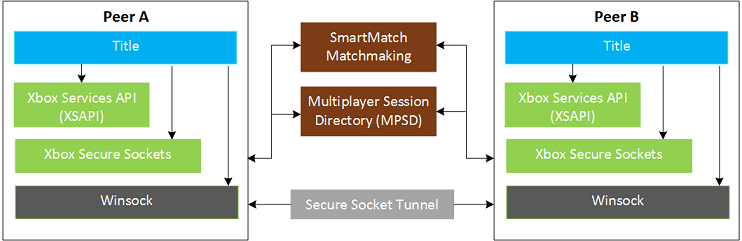
Client/server architecture
In client/server architecture, the title uses MPSD and SmartMatch matchmaking to discover dedicated server addresses. The title then uses the addresses to connect to the dedicated server by using XBOX secure sockets, as shown in the following diagram. For more information, see Introduction to Windows sockets.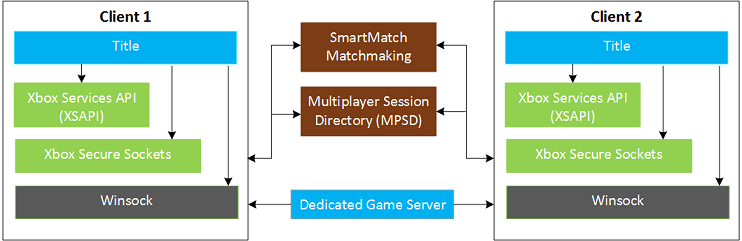
Instances of Azure PlayFab servers can be the servers in client/server architecture. For more information, see Multiplayer Servers.
Parties supported by 2015 Multiplayer
2015 Multiplayer for XBOX One (or later) doesn’t expose the “game party” as a system-level construct. However, it does support the “chat party” at a system level, as did 2014 Multiplayer. And by using MPSD sessions, your titles can still provide player experiences that are similar to those that used the game party.Chat party
A chat party is a group of people who are chatting with each other, managed by the player through the XBOX One Party app. Players can be in a chat party while playing in a game session or while performing another console activity. However, there are no ties between the players in the chat party and other activities for those players. The chat party is exposed by thePartyChat class, which allows the title to examine the state of the chat party. For example, a title can enumerate the members of the chat party by using the PartyChat.GetPartyChatViewAsync method.
Implementing features similar to game party
In 2014 Multiplayer, the game party served several purposes. It allowed a title to:- Advertise a player’s current activity and availability for joins.
- Send invitations (invites) to sessions.
- Discover and join sessions.
- Receive notifications on certain changes to the sessions that are registered to the party.
- Use SmartMatch matchmaking.
- Keep a group of people together across multiple game sessions.
Multiplayer terminology
What’s new in 2015 Multiplayer
New concepts in 2015 Multiplayer
Web socket connections to MPSD
MPSD now enables titles to maintain web socket connections. These connections enable clients to receive notifications when sessions change. For more information, see the section MPSD change notification handling and disconnect detection in the topic “Multiplayer Session Directory overview.”MPSD session handles
2015 Multiplayer adds support for MPSD session handles, which are references to sessions that can include typed data. For more information, see:- The section Session handles in the topic “Multiplayer concepts overview.”
- The section MPSD handles to sessions in the topic “Multiplayer Session Directory overview.”